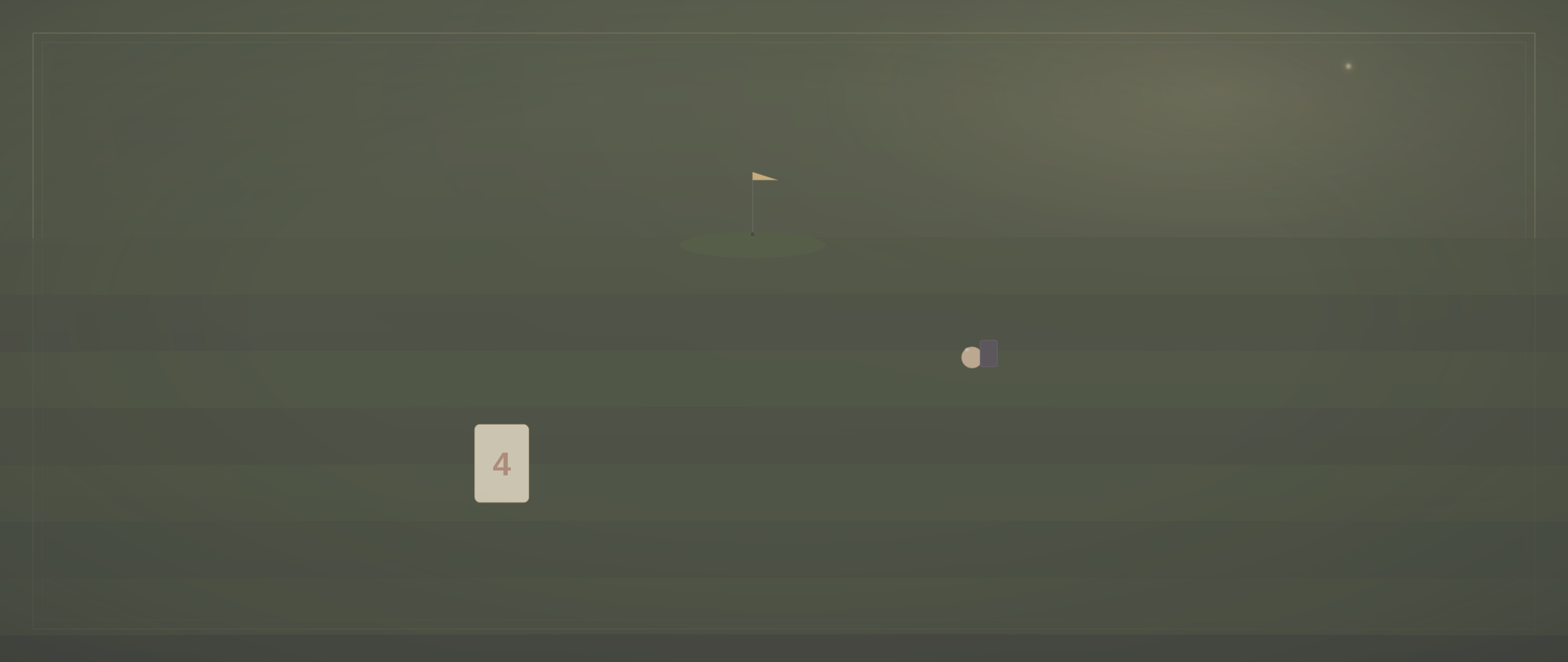
Bogey
Original · a push-your-luck card duel for two
The par is the pin — a stroke for every point you finish short of it, and a stroke for every point past.
Ready to play now.
A demonstration of Bogey, played by the computer against itself.
Bogey — playing itself
Ways to play
Alone, against the computer
Your own pace, no arranging anything. Take a move back whenever you like.
Play alone3 opponents, weakest first
- The DreamerPresses or lays up by the seed. Over two thousand rounds against the Plodder it cards 51.3 strokes to 48.1 and wins 550 matches — it is the sound of a course played without a rule.
- The NervelessLays up the moment the pin is within two. One step too cautious, and one step is enough: from two short another card is expected to finish nearer the pin than standing still does, and giving that stroke away nine holes a round is worth a match. It takes the Dreamer 1348–641 and loses to the Plodder 883–1104.
- The PlodderThe caddie’s rule of thumb, and the top of this ladder because nothing built for this course has beaten it. One short of the pin, lay up; further out, press. It cards 48.1 strokes a round, takes the Nerveless 1104–883 and the Dreamer 1477–515 — and it runs MORE greens than the Nerveless, 9,541 to 7,274 over two thousand rounds, which is the point: the greens it runs are the price of the holes it wins.
Together, in the same room
2 players. One device goes round the table, or everybody plays off the same screen.
Play in the same roomOnline, at a table
A room code, joinable from anywhere. Pause tonight and pick it up next week from your device.
Play online
About
A card duel of golf: nine holes of par three to five and one shared shoe of sixty. On your stroke, press — draw the top card onto your hole — or, once you have drawn, lay up where you stand. The par is the PIN: the hole costs par plus one stroke for every point you finish away from it, short or past alike, and reaching the pin holes you out. Each hole goes to the lower card and a level hole is halved; strokes break a tie on holes. Every card drawn lies face up for both to see, and so does the card your rival has already holed out for.
How it feels
- A 2 when you needed a 2
- Laying up one short and watching them run four past
- A hole you had lost, halved by the last card in the shoe
What the design is for
The par is the pin
You are not staying under the par, you are landing ON it. The hole costs par plus a stroke for every point you finish away from the pin — lay up two short of a par four and you card six; run two past it and you card six as well — and reaching the pin holes you out at par. The only stroke you ever choose is a stroke taken short.
The rule the game is built on
One short of the pin, lay up: a 1 holes you out and every other card in the shoe runs you further past than the single stroke you are dropping. Two short and further out, press: another card is expected to finish nearer the pin than standing still does. That rule is worth a match — the opponent that lays up one step too early loses 883 rounds to 1104 over two thousand.
Match play, so their card is the target
Each hole goes to the lower card and a level hole is halved; strokes break a tie on holes, greens overshot break a tie on strokes. It means the rule above has exceptions the table can see: a lay-up that cannot beat the card your rival has already holed out for is a hole given away, so you press for the card that could still win it.
Nothing hidden but the order
Every card drawn lies face up, the count rail shows how many of each value remain, and the shoe is finite — sixty cards, ten of each value one to six. When it runs dry it is reshuffled, and the discards go with it, so what the rail shows is always a count somebody at the table could keep. The view carries the counts and never the ORDER.
Taught stroke by stroke
Six steps: the press, the pin three short, the lay-up one short, the cost of running past, the hole the rival has already carded — and then the whole course to yourself. Each step accepts the stroke its words ask for.
- Best at
- 2
- Kind
- Party
- Table
- Competitive
- Studio
- Board.game Originals
The opponents
The Dreamer
Presses or lays up by the seed. Over two thousand rounds against the Plodder it cards 51.3 strokes to 48.1 and wins 550 matches — it is the sound of a course played without a rule.
The Nerveless
Lays up the moment the pin is within two. One step too cautious, and one step is enough: from two short another card is expected to finish nearer the pin than standing still does, and giving that stroke away nine holes a round is worth a match. It takes the Dreamer 1348–641 and loses to the Plodder 883–1104.
The Plodder
The caddie’s rule of thumb, and the top of this ladder because nothing built for this course has beaten it. One short of the pin, lay up; further out, press. It cards 48.1 strokes a round, takes the Nerveless 1104–883 and the Dreamer 1477–515 — and it runs MORE greens than the Nerveless, 9,541 to 7,274 over two thousand rounds, which is the point: the greens it runs are the price of the holes it wins.
Achievements
0 of 5 earned
The Round Is Yours
Win a round of Bogey.
Two Greens or Fewer
Win a round having run no more than two greens.
Pressure Par
Hole out dead on the pin from two or more pressed cards.
On the Greens
Win a round level on holes and level on strokes.
Chaos Golfer
Run six greens and still win the match.
Key art
Key art — Board.game art system
More like this
 Board.game Original
Original · push your luck for two
Kindling
Eight frosts in the deck, and every one of them is yours if you push.
2 players5–15 minCompetitive
Playable Board.game Original
Original · a pay-to-pass auction for two
Levy
Every pass costs a coin, every take costs a demand, and runs of demands count once.
2 players10–15 minCompetitive
Playable Board.game Original
Original · a divide-and-choose duel for two
Crumb
I split, you choose — and a matched pair split in two is worth nothing extra to either baker.
2 players2 minCompetitive
Playable Board.game Original
Original · a shared-air gamble for three to six
Sump
The air belongs to everybody. The gold belongs to whoever turns back.
3–6 players10–15 minCompetitive
Playable Board.game Original
Original · three to five players
Third Lantern
A paper lantern needs two hands, and nobody will tell you whose.
3–5 players5–10 minCompetitive
Playable Board.game Original
Original · an auction for three to five
Gavel
Every coin you spend is a point you no longer have.
3–5 players10–20 minCompetitive
Playable Board.game Original
Original · a memory duel for two
Darkroom
The only thing hidden is where anything is.
2 players2–3 minCompetitive
Playable
Fifteen minutes, four people
The Last Tram
One seat. Everyone wants it. The tram is not waiting.
2–4 players10–15 minCompetitive
Playable